


(0)1622 589 999

info@allfloorstradecenter.co.uk


There’s no end to trip and slip accidents on floors, causing anything from mild to severe injuries. For that reason, anti-slip flooring can be a lifesaver, but what is safety flooring? We’ll address that and more. So, tag along to learn more about safe flooring, its benefits, and styles.
Anti-slip waterproof flooring is a type of flooring that reduces the slip risk, creating a safe environment in low and high traffic areas. With the use of safety aggregates and particles, friction between the floor and your foot increases.
So, in cases of contaminant spillage, you and your family members are less likely to be injured. In short, the flooring has higher traction and underfoot safety.
Still, how can you tell that a product is indeed slip-resistant in wet conditions? Simply put, it should follow the European standard for particle-based safety flooring, EN 13845. As for products that meet other flooring standards, including EN ISO 10581/10582, EN 649, EN 548, EN 12199, and EN 1817, they aren’t classified as safety floors.

Typically, spilt contaminants on the flooring, including grease, water, and shampoo, create a squeeze film between your foot and the floor.
However, non-slip floor covering uses aggregates in its wear layer during production. And the aggregates merge with the floor’s surface, making for a harder friction surface.
Then, enough high-quality aggregates penetrate the wet film. And they make contact with your shoes or prevent dry contaminants’ ball bearing effect. This way, pollutants have less of an impact.
If you’re wondering why you should install safety vinyl flooring, the peace of mind that this flooring grants you is priceless. In places with high foot traffic, you can rest assured that your anti-slip vinyl sheet flooring or other anti-slip floorings will minimize the slip risk.
In terms of hygiene, non-slip vinyl sheet flooring and other similar types are easy to maintain and clean because they don’t absorb spillages and resist bacteria and germs. Accordingly, they can be the perfect match for healthcare facilities. And speaking of maintenance, you might want to check out our tips for effective floor cleaning and maintenance.
Moreover, slip resistant vinyl flooring is highly durable and hard wearing, which makes it a worthwhile investment.
We’ve already alluded to this when we called non-slip flooring non-slip vinyl flooring. But aside from vinyl, the flooring contains quartz, silicon carbide, and aluminium oxides, which contribute to its anti-slip feature.
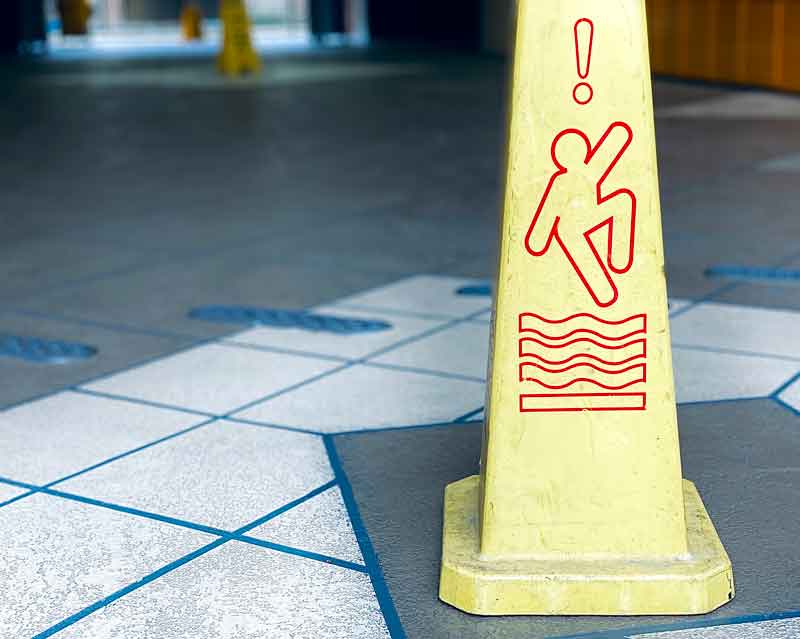
Non-slip cushioned vinyl flooring is designed for work environments, commercial use, and public spaces, including shops, schools, and hospitals because of its hard-wearing nature.
But you may wonder if non-slip vinyl click flooring gets wet when it’s slippery. It may get wet, but it handles water impressively well. So, you can clean it with a traditional mop and bucket; there’s no need for expensive specialised cleaners and polishers.
First off, we want to establish the fact that there’s a difference between high risk of slipping environments and very high risk of slipping environments.
But don’t worry because we can help guide you to purchase your dream flooring. Just contact us at AllFloors Trade Centre. You can use our number 01622589999, our email address, info@allfloorstradecentre.co.uk, or our online form. We’ll be happy to assist you!
A very high risk of slipping environment can be hazardous, as contaminants are always there and you can’t avoid spillage. That’s certainly the case for swimming pool areas. However, a high risk of slipping environment is one where the contaminant is spilt, like water, soap, and so on.
Luckily, there’s a solution to implement in very high risk of slipping environments: slip resistant flooring. At All Floors Trade Centre, we offer a wide selection of safety flooring options with sustainable slip resistance, hygienic properties, and barely any maintenance required.
Furthermore, slip resistant flooring can be used in hospitals, schools, nurseries, toilets, bathrooms, kitchens, retail sectors, and care homes.
If you want to learn more about our products, feel free to contact us.
A high risk of slipping environment is one with an increased risk of injury due to slipping. We’re talking about a surface with a spilt substance, such as water, on top of it. So, that can happen in kitchens, bathrooms, and more.
High risk of slipping environments differ from very high risk of slipping environments in that the substance or contaminant isn’t constantly present, so there’s less chance of injury involved.
According to the North Carolina Department of Labor’s “A Guide to Fall Prevention in Industry”, when we look at the least slippery flooring types, they usually have the following features:
Furthermore, slip resistant alternatives are asphalt, wood, cork, low-pile carpeting, and more. And when you couple anti-slip flooring with proper installation and maintenance, you can indeed prevent slips and falls. Now, let’s dissect these flooring alternatives.
To start with, asphalt is probably ideal for damp conditions. It’s also cheap, so you can use it for a residential basement or any commercial use. However, we have to note that asphalt tiles are very challenging when it comes to their removal. So, only opt for asphalt if you’re sure you want to keep it.
Moving on, non-slip wood flooring is a classic and aesthetically pleasing option. Usually, you’ll find it in residential spaces, but it can also exist in commercial areas. Additionally, manufacturers add artificial abrasives or metallic particles to the flooring’s varnish to make it safe.
Tip: If you’re going for hardwood flooring, we’d recommend cleaning off spills instantly and not using area rugs.
Furthermore, cork isn’t just a type of slip resistant flooring; it also absorbs sound and offers you cushioning underfoot. As for its production, manufacturers blend compressed and moulded ground cork bark with natural cork resin. Then, they heat-cure the components under pressure, thus binding them.
Unlike asphalt, cork is expensive. And it’s found in commercial and residential settings. The one downside is that cork isn’t sustainable, as it requires removing the trees’ bark rather than cutting it down.
And another type of slip resistant flooring is low-pile or indoor-outdoor carpeting. It employs manufactured fibres (like olefin) or natural fibres (like jute). A low-pile carpet isn’t only resistant to stains but also ultraviolet light.
Additionally, it might feature marine backing to handle moisture if it’ll be placed in damp areas. Usually, a non-slip floor covering is used in sunrooms and porches.

Kids are always getting into accidents, so it’s especially crucial to make their spaces slip resistant, whether that’s a playroom, playground, or kids’ room. So, let’s delve into some features to look for when you’re choosing the ideal safety flooring for kids.
Firstly, in a playground with equipment, kids need fall protection. This way, if they fall off any equipment, they aren’t severely injured. So, opt for flooring with the required fall height protection rating. In other words, it should at least match the height of the tallest playground equipment piece.
Secondly, playground flooring should have good traction. And if you’ll use it outdoors, its traction should remain solid even in wet conditions.
Thirdly, since flooring for kids will probably witness plenty of traffic, it should be durable. That’s especially true for public and commercial settings.
Fourthly, if the playground is going to be outdoors, it should have a quality drainage system, be UV protected or stable, and be weather-proof. This way, outdoor conditions won’t undermine its quality.
Tip: If there are other features that you require in your kids’ flooring surface, such as flooring that can be used with underfloor heating, make sure that your flooring type is compatible with that.
If you’re looking for non-slip kitchen flooring, we’ve got you. Kitchens are constantly exposed to moisture, dirt, and spills. Not to mention, the entire family probably keeps walking in and out every second. For those reasons and more, it’s best to use the following types of flooring for kitchens.
First of all, hardwood flooring is durable, water-resistant, and warm. And how resistant it is to slipping depends on its finish. However, prolonged exposure to moisture can undermine hardwood’s quality. Second of all, non-slip laminate flooring is waterproof, warm, and easy to install. It also resembles traditional hardwood.
Third of all, safety tiles are a durable solution for wet areas. This is also the most commonly used flooring for kitchens. And it has multiple types, so you have non-slip vinyl flooring for kitchens, ceramic, porcelain, natural stone, stained concrete, and much more.
Speaking of non-slip ceramic and porcelain, this type can handle messes, splatters, and spills. However, it would be best if you still cleaned it fast to avoid grout staining. As for porcelain, it’s 100% waterproof and highly durable. Typically, these non-slip varieties look like wood or natural stone.
Otherwise, non-slip vinyl flooring may use foam or cork backing for a soft underfoot. And it’s waterproof as well. As for stained concrete, the regular varieties are slippery due to their finish. But some options are certainly less slippery. They’re also very durable and waterproof.
Before we get into the best flooring for a wet room or an open shower, we should establish what that is exactly. A wet room is a bathroom with tanked floors and walls. That’s to say that all surfaces are sealed using a type of waterproof membrane, which prevents water damage.
And it usually includes a shower, sometimes with a glass screen. In addition, wet rooms tend to have sloping floors so that water can slide to a drain or waste. This way, you can get rid of excess water.
As for the best flooring for wet rooms, that flooring should preserve the integrity of the bathroom and be safe for you and your family.
Accordingly, we have to go with non-slip vinyl bathroom floor tiles. That’s because of their anti-slip features, flexibility, versatility, and water resistance. On top of that, if you want a non-slip vinyl flooring bathroom, you’ll be happy to learn that it’s easy to install and remove this flooring.
Nonetheless, if you’re looking for other non-slip bathroom flooring ideas, you might want to consider mosaic flooring. This anti-slip bathroom flooring is used in pools as well, thanks to its top-notch slip resistance feature.
Since safety flooring is made to be stain resistant, you can’t stain it with paint and oil. Not to mention, even if you manage to paint it, you’ll be covering its non-slip surface. So, it’ll be slippery, defying the entire purpose of safety flooring.
Ultimately, safety flooring is used in residential and commercial settings to reduce the slip risk, thus decreasing the chances of injury. And the secret lies in using aggregates to enhance the flooring’s traction. Also, safety floors aren’t only safer, but they’re also more hygienic and hard wearing.
Undoubtedly, there are different styles of safety flooring and different levels of risk involved in various circumstances, so you need to assess these different factors to decide on the proper safety flooring to use.