


(0)1622 589 999

info@allfloorstradecenter.co.uk

Chances are you’re looking for floor renovation ideas. And you probably want to learn about the top flooring trends of 2022. As a homeowner, property developer, or designer, you want to ensure that every room in the house is up-to-date and eye-catching. After all, you don’t want to splurge on your flooring only for it to become old fashioned in some years.

We’ll tackle the home flooring ideas that involve types of flooring, features, colours, patterns, textures, layouts, looks, and look-alikes. This way, you’ll know everything you need to know before diving into your project.
Hardwood flooring is a very consistent option. It’s a classic, especially for the main areas of the property. The trend for hardwood flooring is to get wide and long planks. So, we’re talking 18” to 20” wide and 12’ long or more. As for the finishes, we expect a lot of natural penetrating/hard-wax oil with no sheen.
Vinyl floors are trending right now, and there are some vinyl trends you shouldn’t miss. For one, we have WPC (wood plastic composite) vinyl. It’s like luxury vinyl floors with waterproof properties and resembles wood. Then, SPC vinyl floors are marked by their rigid core, which reduces ripples and waves. Accordingly, they’re perfect for uneven subfloors.
We can’t forget luxury vinyl planks (LVP), durable and stunning but not waterproof. As for luxury vinyl tiles (LVT), they closely mimic the stone look. Last but not least, vinyl sheets have fibreglass cores and backing to enhance durability. In addition, these sheets come in realistic textures and decorative designs.
Tip: Compile a mental list of all the features you need in your flooring types, such as safety features, water resistance, and more.
When it comes to tiles, we’ve got terrazzo. It’s made by collecting marble flecks, which gives it a versatile and vintage look. Then, green tiles can be anything from cool to bold (depending on the shade).
We also expect a lot of bold patterns. These can give your place character and add spice! Moroccan-style tiles are also in fashion, inviting warmth into your house with intricate designs. Finally, deep blue tiles are luxurious and chick.
2022 is coming strong with colours. We expect to see bold, colourful, and patterned carpets in small rooms. An incredibly trendy pattern is that of carpet tiles. They have a very abstract look and are practical. Another pattern we expect to see more of is smart stripes; they give off the illusion of space.
When it comes to popular colours, there are soft duck egg blues, as usual, and black and teal tones with flashy accents. But we also love the hot tones, such as lush berry and spicy chilli. They’re ideal for high-foot traffic areas. And we have the plain naturals for the minimalists. They’ll easily go with anything and promote relaxation.

The features you want in your flooring should be relevant to the most popular flooring in new homes. So, you want waterproof flooring, as it’s more durable when it comes to scratching, staining, and humidity.
That can be WPS vinyl, SPC vinyl, and more. There are also waterproof types of trendy laminate flooring, engineered hardwood, and even carpet with fibre coating!
Moreover, eco-friendly flooring is on the rise. Tiles and environmental friendliness go hand in hand. These natural products give you the natural look and texture you want. You can opt for terrazzo or statement marble.
As for carpeting, eco-friendliness translates to recycled carpet flooring. Yes, manufacturers mostly make carpets from recycled materials, including fishing nets and plastic soda bottles. They’re even taking it a step further to make the carpet more recyclable.
Moreover, a feature that we can’t miss is American-made flooring. We don’t know if this trend will ripple into the UK, but the rise of American-made flooring is due to Americans’ preference to support their economy.
Other than that, this feature also overlaps with the previous one in that many American-made flooring products are sustainable and eco-friendly.
Starting off, we have wood, which rarely goes out of fashion, and the same goes for wood looks. Firstly, you have laminate planks, the most economical wood-like flooring option.
Secondly, ceramic and porcelain tiles with wood looks are sturdy and waterproof. Thirdly, wood-look vinyl planks also bear a startling resemblance to real wood.
Also, due to its accessibility, stone-look flooring is gaining more popularity, especially the following looks. We have concrete-look flooring for more minimalist styles, which has an industrial look to it.
Moreover, limestone flooring has the natural look with multiple colour variations. As for travertine-look flooring, it’s been getting its well-earned attention lately with modern flooring styles and designer patterns.
And if you’re looking for “high-end luxury” that doesn’t cost an arm and a leg, check out marble-look flooring. You’ll find it in intricate patterns, and you can take pleasure in knowing that no one else has your exact flooring!
Furthermore, you could opt for slate-looking flooring. It assumes the look of ceramic and vinyl tiles, giving you a natural marble look.
Last but not least, you might appreciate decorative floors if you aren’t about the natural-flooring look. Examples include geometric patterns, trellis designs, and parquet patterns. These are trendy choices for bathrooms.
When it comes to in-style flooring colours, the phrase “grey is the new beige” comes to mind. Classic grey is only getting more popular, and designers are mixing it with beige to make stylish greige shades.
Grey is super popular, and it’s one of the most modern wood floor (check out our article on how to fix wood floor) colours. But you’ll find that grey stone flooring is popular as well. After all, it can so easily match your home’s aesthetic and give it a contemporary feel.
We expect to see more white and white undertones in 2022. These marble-look floors should brighten any room and make it look larger.
But even more important is white-washed flooring, especially common in coastal homes and farmhouses. Like real white flooring, white-washed flooring adds light to a room and balances the contrast of its colours.
White-washing doesn’t strip the wood of its grainy charm, but it encloses it in a white ash exterior. That means you can bleach your existing hardwood floors, which is expensive. Otherwise, you can replace them with ready-made white-washed floors.
Additionally, it’s trendy to have cool-toned flooring. We’re mostly talking about blue and green carpets, vinyl floors, and decorative floors but also light cool tones for stone and wood looks. If you’re worried about warm colours replacing cool ones soon, consider a muted tone that won’t go out of style for a while, such as grey-blue.
Moving on, you’ll find many woods, wood-look, and tile floors in high-colour variations. Their seemingly random colour designs give off a natural and rustic feel. For that reason, they’re excellent for minimalistic and contemporary flooring options. In wood, the colour variation is evident between planks, but in tiles, it’s evident if you look at the individual tile.
Then, black and white floors are coming back, stronger than ever with a new and improved look. But these aren’t the tiles you remember from historic homes. Instead, they feature more graphic designs, sometimes on smaller tiles. And you can pair them with vibrant tones in a small space to add a pop of colours.
The appeal of black and white is that it can contribute to a modern or a vintage look. So, you might want to consider it for a bathroom or a corridor. Perhaps even go with a checkerboard laying. Nonetheless, know that this isn’t a trend that’ll stay for long.
We’ve briefly alluded to the first of several flooring layouts, and that’s longer and wider planks. These planks give the illusion of space.
Chevron floors are also in, flaunting their arrow-like home flooring design. They’re laid one against the other with a 45-degree angle to create a point. Chevron flooring is one way to make a statement in a bedroom!
But we can’t talk about chevron floors without bringing up herringbone ones. These have a zig-zag pattern by laying two planks at a 90-degree angle. A rising trend involves mixing herringbone with plain stripes. Also, you can find built-in chevron or herringbone patterns to ease application. Either choice will spice up your kitchen.
In addition, a layout we’ve mentioned earlier is the checkerboard style. This classic layout for kitchens and bathrooms is everywhere. And the checkered trend isn’t specific to black and white, so you can buy these tiles in various colours and designer prints.
Additionally, the creative tile transitions have stepped in to replace traditional straight-line transitions. These transitions blend contrasting floor types, such as tiles and planks, enabling you to transition from a room to another in a creative way.
Let’s take a minute to talk about the trending flooring texture 2022. For one, wire-brushed and weathered looks are still not out. These are the floors with intentional wire scratches. After all, they don’t look dirty easily, requiring little maintenance.
Another trending texture is distressed flooring. Its intentional scrapes, bums, and knotholes give it character. The historic-looking texture looks excellent with brick walls, stacked stone, and interior design trends.
Smooth flavours are still classic, chic, and some of the best flooring options. They’re the default, so we know they’ll probably never be a thing of the past.
Tip: If you’re looking to renovate the yard, you should check out this guide about artificial grass installation.
We’re talking about floor textures, but what about carpet textures? Firstly, frieze or twist carpets feature carpet fibres with several twists. The shag trending style is very cute, and it’s everywhere.
Secondly, cut and loop carpets are getting much attention right now. These hybrid carpets mix cut carpet fibres with looped carpet fibres, producing different textures.
Many materials appear to be natural wood but aren’t, and they’re at the forefront. For instance, porcelain tiles are waterproof and way more durable than hardwood.
Then, there’s engineered vinyl planks/ luxury vinyl, typically waterproof and bears a remarkable resemblance to wood. Luxury vinyl is also a hardwood look-alike, but it may not be waterproof.
If you’re worried that hardwood may not be very sustainable, bamboo, cork, and terrazzo are eco-friendly alternatives that have its look.
As for dark wood laminates, the latest laminate flooring trends include a departure from them to lighter ones. Furthermore, parquet patterns are some decorative styles that resemble wood, and their cold tones are popular wood floor colours. We’re talking grey wood look-alikes, which make for modern styles.
As for the hardwood look-alike planks, they’re getting longer and wider as you already know. And of course, we can’t forget the distressed wood texture with its scrapes, bums, and knotholes, its fake wood texture resembling real weathered wood.

Not just any type of vinyl flooring is becoming popular but wide plank vinyl flooring. It’s taking over the market and replacing solid wood and engineered wood.
That’s because luxury vinyl tiles, a type of vinyl flooring, feature a high-performing system that people love. Also, people’s choice of replacement flooring in residential markets is vinyl flooring, responsible for 47.8% of the vinyl flooring market. And, of course, it’s inexpensive, durable, and easy to maintain.
We’re already given you tons of predictions, but we’ll recap the main ones to help you find the most popular and the best flooring in new homes. We have smoked wood floors, which are marked by their rich colour. There’s also white-washed wood with a soft look.
And weathered wood with a distressed texture is harbouring popularity recently. But then, there are patterned floors, black and white tiles, graphic ones, and more.
We’ve talked about greys and light tones being trendy, but you might want a colour that has more staying power. We’re referring to mid-tones. A colour that’s neither too light nor too dark is unlikely to look old fashioned in years.
When it comes to bedroom flooring trends, you’ll find modern designs trending. You can achieve that with earth tones, wide plank wood-looks, and tile floors with clean lines.
Otherwise, farmhouse bedrooms come with grey, white and neutral colours, earth tones for carpets, rustic area rugs, and wood-look floors.
As for vintage bedrooms, they’re trendy as usual. Use plush carpet rolls and minimalist area rugs to get a vintage bedroom.
Let’s focus a little on some kitchen flooring trends. People are using large format flagstones, which are hardwearing and timeless. As for stone colours, we’re seeing a shift from grey to beige tones.
There are also oak wood-look kitchen tiles, adding warmth to the kitchen. Other trends that we’ve talked about include herringbones, chevron, and white-washed wood-looks.
Overall, we hope you’ve learned some modern flooring ideas in 2022 so that you can renovate your floors in style. This way, it’ll look up-to-date for years to come. There are numerous trends for flooring types, styles, textures, patterns, looks, colours, and more.
All you have to do is decide on an aesthetic, classic, modern, vintage, minimalistic, or else. And choose the trends that better match your aesthetic.
Get in touch with us today if you need advice on choosing your flooring.
There’s no end to trip and slip accidents on floors, causing anything from mild to severe injuries. For that reason, anti-slip flooring can be a lifesaver, but what is safety flooring? We’ll address that and more. So, tag along to learn more about safe flooring, its benefits, and styles.
Anti-slip waterproof flooring is a type of flooring that reduces the slip risk, creating a safe environment in low and high traffic areas. With the use of safety aggregates and particles, friction between the floor and your foot increases.
So, in cases of contaminant spillage, you and your family members are less likely to be injured. In short, the flooring has higher traction and underfoot safety.
Still, how can you tell that a product is indeed slip-resistant in wet conditions? Simply put, it should follow the European standard for particle-based safety flooring, EN 13845. As for products that meet other flooring standards, including EN ISO 10581/10582, EN 649, EN 548, EN 12199, and EN 1817, they aren’t classified as safety floors.

Typically, spilt contaminants on the flooring, including grease, water, and shampoo, create a squeeze film between your foot and the floor.
However, non-slip floor covering uses aggregates in its wear layer during production. And the aggregates merge with the floor’s surface, making for a harder friction surface.
Then, enough high-quality aggregates penetrate the wet film. And they make contact with your shoes or prevent dry contaminants’ ball bearing effect. This way, pollutants have less of an impact.
If you’re wondering why you should install safety vinyl flooring, the peace of mind that this flooring grants you is priceless. In places with high foot traffic, you can rest assured that your anti-slip vinyl sheet flooring or other anti-slip floorings will minimize the slip risk.
In terms of hygiene, non-slip vinyl sheet flooring and other similar types are easy to maintain and clean because they don’t absorb spillages and resist bacteria and germs. Accordingly, they can be the perfect match for healthcare facilities. And speaking of maintenance, you might want to check out our tips for effective floor cleaning and maintenance.
Moreover, slip resistant vinyl flooring is highly durable and hard wearing, which makes it a worthwhile investment.
We’ve already alluded to this when we called non-slip flooring non-slip vinyl flooring. But aside from vinyl, the flooring contains quartz, silicon carbide, and aluminium oxides, which contribute to its anti-slip feature.
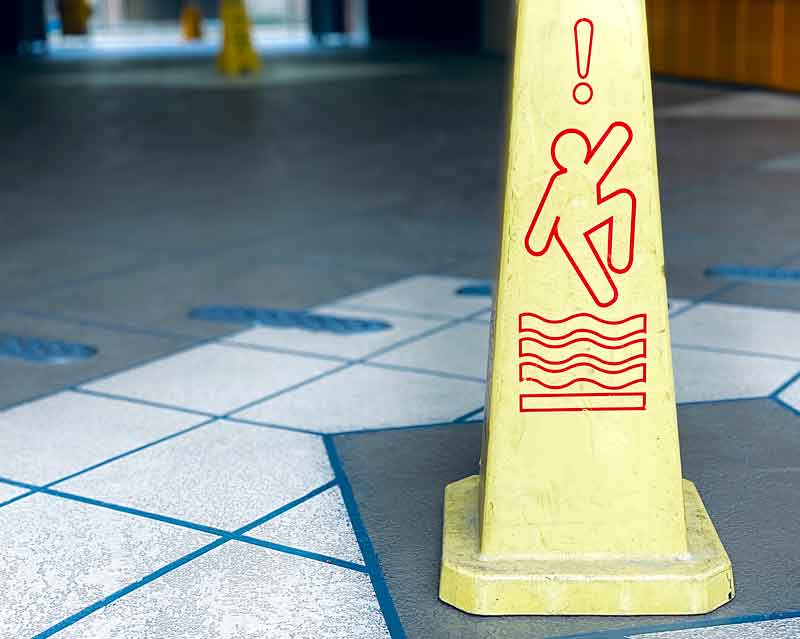
Non-slip cushioned vinyl flooring is designed for work environments, commercial use, and public spaces, including shops, schools, and hospitals because of its hard-wearing nature.
But you may wonder if non-slip vinyl click flooring gets wet when it’s slippery. It may get wet, but it handles water impressively well. So, you can clean it with a traditional mop and bucket; there’s no need for expensive specialised cleaners and polishers.
First off, we want to establish the fact that there’s a difference between high risk of slipping environments and very high risk of slipping environments.
But don’t worry because we can help guide you to purchase your dream flooring. Just contact us at AllFloors Trade Centre. You can use our number 01622589999, our email address, info@allfloorstradecentre.co.uk, or our online form. We’ll be happy to assist you!
A very high risk of slipping environment can be hazardous, as contaminants are always there and you can’t avoid spillage. That’s certainly the case for swimming pool areas. However, a high risk of slipping environment is one where the contaminant is spilt, like water, soap, and so on.
Luckily, there’s a solution to implement in very high risk of slipping environments: slip resistant flooring. At All Floors Trade Centre, we offer a wide selection of safety flooring options with sustainable slip resistance, hygienic properties, and barely any maintenance required.
Furthermore, slip resistant flooring can be used in hospitals, schools, nurseries, toilets, bathrooms, kitchens, retail sectors, and care homes.
If you want to learn more about our products, feel free to contact us.
A high risk of slipping environment is one with an increased risk of injury due to slipping. We’re talking about a surface with a spilt substance, such as water, on top of it. So, that can happen in kitchens, bathrooms, and more.
High risk of slipping environments differ from very high risk of slipping environments in that the substance or contaminant isn’t constantly present, so there’s less chance of injury involved.
According to the North Carolina Department of Labor’s “A Guide to Fall Prevention in Industry”, when we look at the least slippery flooring types, they usually have the following features:
Furthermore, slip resistant alternatives are asphalt, wood, cork, low-pile carpeting, and more. And when you couple anti-slip flooring with proper installation and maintenance, you can indeed prevent slips and falls. Now, let’s dissect these flooring alternatives.
To start with, asphalt is probably ideal for damp conditions. It’s also cheap, so you can use it for a residential basement or any commercial use. However, we have to note that asphalt tiles are very challenging when it comes to their removal. So, only opt for asphalt if you’re sure you want to keep it.
Moving on, non-slip wood flooring is a classic and aesthetically pleasing option. Usually, you’ll find it in residential spaces, but it can also exist in commercial areas. Additionally, manufacturers add artificial abrasives or metallic particles to the flooring’s varnish to make it safe.
Tip: If you’re going for hardwood flooring, we’d recommend cleaning off spills instantly and not using area rugs.
Furthermore, cork isn’t just a type of slip resistant flooring; it also absorbs sound and offers you cushioning underfoot. As for its production, manufacturers blend compressed and moulded ground cork bark with natural cork resin. Then, they heat-cure the components under pressure, thus binding them.
Unlike asphalt, cork is expensive. And it’s found in commercial and residential settings. The one downside is that cork isn’t sustainable, as it requires removing the trees’ bark rather than cutting it down.
And another type of slip resistant flooring is low-pile or indoor-outdoor carpeting. It employs manufactured fibres (like olefin) or natural fibres (like jute). A low-pile carpet isn’t only resistant to stains but also ultraviolet light.
Additionally, it might feature marine backing to handle moisture if it’ll be placed in damp areas. Usually, a non-slip floor covering is used in sunrooms and porches.

Kids are always getting into accidents, so it’s especially crucial to make their spaces slip resistant, whether that’s a playroom, playground, or kids’ room. So, let’s delve into some features to look for when you’re choosing the ideal safety flooring for kids.
Firstly, in a playground with equipment, kids need fall protection. This way, if they fall off any equipment, they aren’t severely injured. So, opt for flooring with the required fall height protection rating. In other words, it should at least match the height of the tallest playground equipment piece.
Secondly, playground flooring should have good traction. And if you’ll use it outdoors, its traction should remain solid even in wet conditions.
Thirdly, since flooring for kids will probably witness plenty of traffic, it should be durable. That’s especially true for public and commercial settings.
Fourthly, if the playground is going to be outdoors, it should have a quality drainage system, be UV protected or stable, and be weather-proof. This way, outdoor conditions won’t undermine its quality.
Tip: If there are other features that you require in your kids’ flooring surface, such as flooring that can be used with underfloor heating, make sure that your flooring type is compatible with that.
If you’re looking for non-slip kitchen flooring, we’ve got you. Kitchens are constantly exposed to moisture, dirt, and spills. Not to mention, the entire family probably keeps walking in and out every second. For those reasons and more, it’s best to use the following types of flooring for kitchens.
First of all, hardwood flooring is durable, water-resistant, and warm. And how resistant it is to slipping depends on its finish. However, prolonged exposure to moisture can undermine hardwood’s quality. Second of all, non-slip laminate flooring is waterproof, warm, and easy to install. It also resembles traditional hardwood.
Third of all, safety tiles are a durable solution for wet areas. This is also the most commonly used flooring for kitchens. And it has multiple types, so you have non-slip vinyl flooring for kitchens, ceramic, porcelain, natural stone, stained concrete, and much more.
Speaking of non-slip ceramic and porcelain, this type can handle messes, splatters, and spills. However, it would be best if you still cleaned it fast to avoid grout staining. As for porcelain, it’s 100% waterproof and highly durable. Typically, these non-slip varieties look like wood or natural stone.
Otherwise, non-slip vinyl flooring may use foam or cork backing for a soft underfoot. And it’s waterproof as well. As for stained concrete, the regular varieties are slippery due to their finish. But some options are certainly less slippery. They’re also very durable and waterproof.
Before we get into the best flooring for a wet room or an open shower, we should establish what that is exactly. A wet room is a bathroom with tanked floors and walls. That’s to say that all surfaces are sealed using a type of waterproof membrane, which prevents water damage.
And it usually includes a shower, sometimes with a glass screen. In addition, wet rooms tend to have sloping floors so that water can slide to a drain or waste. This way, you can get rid of excess water.
As for the best flooring for wet rooms, that flooring should preserve the integrity of the bathroom and be safe for you and your family.
Accordingly, we have to go with non-slip vinyl bathroom floor tiles. That’s because of their anti-slip features, flexibility, versatility, and water resistance. On top of that, if you want a non-slip vinyl flooring bathroom, you’ll be happy to learn that it’s easy to install and remove this flooring.
Nonetheless, if you’re looking for other non-slip bathroom flooring ideas, you might want to consider mosaic flooring. This anti-slip bathroom flooring is used in pools as well, thanks to its top-notch slip resistance feature.
Since safety flooring is made to be stain resistant, you can’t stain it with paint and oil. Not to mention, even if you manage to paint it, you’ll be covering its non-slip surface. So, it’ll be slippery, defying the entire purpose of safety flooring.
Ultimately, safety flooring is used in residential and commercial settings to reduce the slip risk, thus decreasing the chances of injury. And the secret lies in using aggregates to enhance the flooring’s traction. Also, safety floors aren’t only safer, but they’re also more hygienic and hard wearing.
Undoubtedly, there are different styles of safety flooring and different levels of risk involved in various circumstances, so you need to assess these different factors to decide on the proper safety flooring to use.